
Wildfire Preparedness for Your Home
By Margaret Kreder, Forestry & Wildlife Program Coordinator at Mason Conservation District
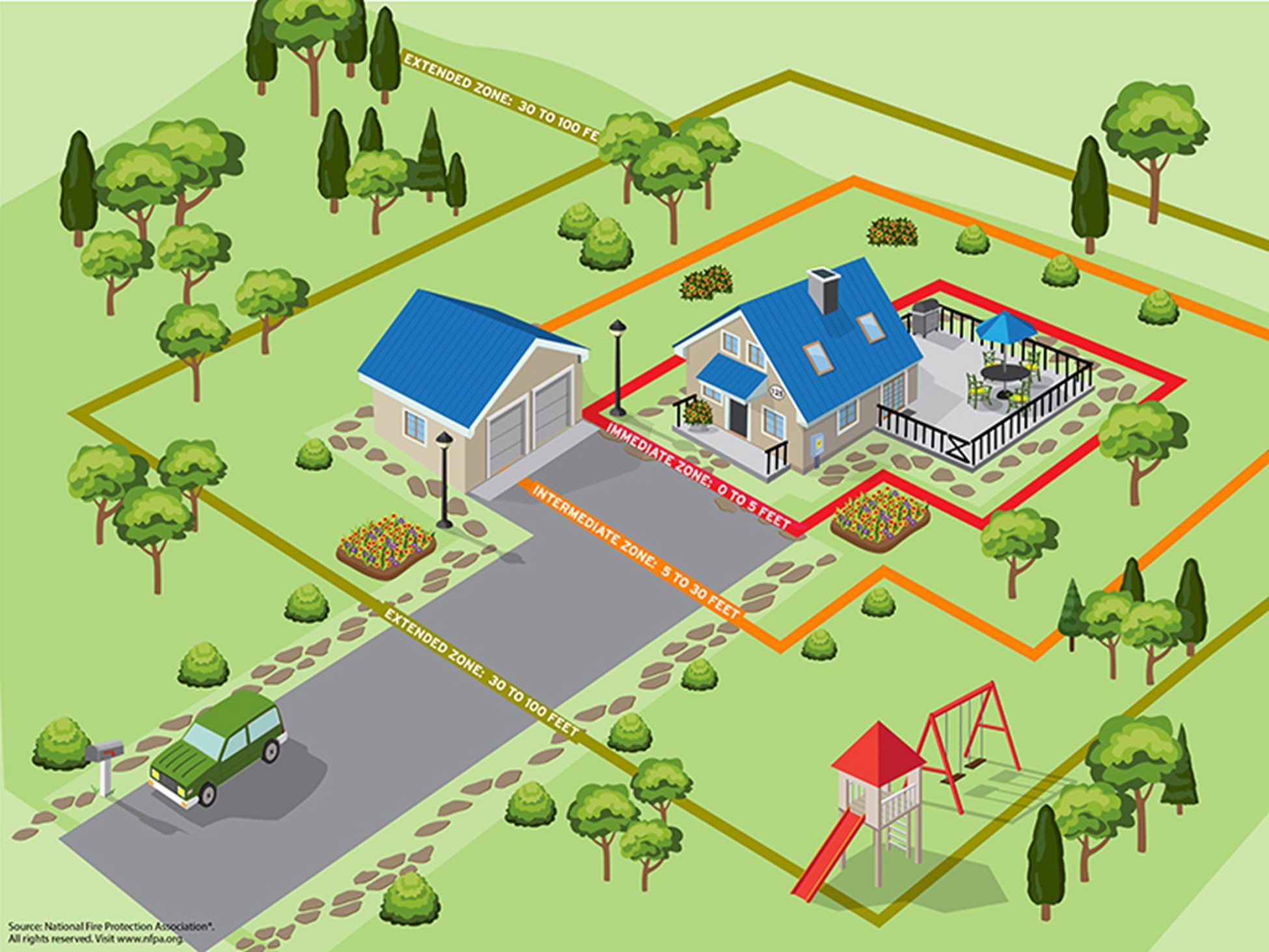
The NFPA illustration visualizes the three Home Ignition Zones as well as showing some of the best practices recommended to improve wildfire resiliency and reduce structural ignition. These practices include placing garden beds outside of the immediate zone, maintaining trees and shrubs in non-contiguous formations, placing non-combustible materials around the home, and only attaching non-flammable fencing to the structure.
As the days get longer and spring approaches, we start to think about all the things that need to be done around the house: cleaning out the fridge, deep cleaning the shower, washing the windows, etc. Spring is also a great time to start thinking about wildfire preparedness. Some of the typical spring-cleaning tasks you may already be doing, which can double as wildfire preparedness activities, include cleaning the roof and gutters of debris, sweeping off the deck or porch, and checking window screening is securely in place. But if you’re ready to take the next step in preparing your home, we have some tips!
During a wildfire event, the most common cause of home ignition is not necessarily direct flame contact from the fire front. Researchers have found that embers and firebrands are some of the major causes of home ignition. Embers in this case are small pieces of burning material that become airborne and have the potential to land far from the fire and ignite flammable materials where they land when the conditions are right. That flammable material could be dry leaves in your gutters or bark mulch at the base of your home. It’s also important to note that embers can not only stem from major wildfires but also from recreational or debris fires.
The National Fire Protection Association (NFPA) states that one of the most important areas to focus on to reduce the risk of ignition from wildfire is the exterior of your home and the 5-foot area immediately around it (The Immediate Zone). In addition to the activities noted above, a few highly recommended practices from NFPA include the following:
- Replace or repair any loose or missing shingles or roof tiles to prevent ember penetration.
- Reduce embers that could pass through vents in the eaves by installing 1/8th inch metal mesh screening.
- Move any flammable material away from wall exteriors – mulch, flammable plants, leaves and needles, firewood piles – anything that can burn. Remove anything stored underneath decks or porches.
Once you’ve taken care of the primary items of concern in the Immediate Zone, then you can start to look further out at the Intermediate (5-30 ft) and Extended (30-100+ ft) Zones. This is where recommendations may become more personalized based on your property and its location, so please reach out to your local fire district or Jefferson County Conservation District to arrange a free individual site visit to determine next steps! You can also go to NFPA.org/Firewise to see more information on how to prepare your home or how to get your community involved in the Firewise USA® program.
Contact information:
Jefferson County Conservation District
360-385-4105
This project has been funded wholly or in part by the United States Environmental Protection Agency under assistance agreement PC-01J89501 through the Washington Department of Fish and Wildlife. The contents of this document do not necessarily reflect the views and policies of the Environmental Protection Agency or the Washington Department of Fish and Wildlife, nor does mention of trade names or commercial products constitute endorsement or recommendation for use.